THE LINUX FOUNDATION PROJECTS
Category

Workshop

The ELISA Project Continues to Grow its Global Ecosystem by Welcoming Red Hat as a Premier Member and Banma, Lotus Cars and SUSE

By Announcement, News, Working Group, Workshop

Schedule for the ELISA Fall Workshop on November 8-10 is now live

SAN FRANCISCO – October 20, 2021 – Today, the ELISA (Enabling Linux in Safety Applications) Project, an open source initiative that aims to create a shared set of tools and processes to help companies build and certify Linux-based safety-critical applications and systems, announced that Red Hat has upgraded its membership to premier member and welcomes Banma, Lotus Cars and SUSE as the newest members.

Linux is used in all major industries because it can enable faster time to market for new features and take advantage of the quality of the code development processes.  Launched in February 2019 by the Linux Foundation, ELISA works with Linux kernel and safety communities to agree on what should be considered when Linux is to  be used in safety-critical systems.

“Linux underpins many applications today that have safety-critical and cybersecurity implications,” said Kate Stewart, Vice President of Dependable Embedded Systems at The Linux Foundation. “By collaborating together, the ELISA members are defining the best practices for use of Linux in these systems. We look forward to continuing to build consensus and welcoming expertise and collaboration from these new members.”

Attend the Fall Workshop

Since its inception, ELISA has hosted quarterly workshops that bring together project members and community contributors to discuss working group updates, trends in functional safety, use cases and more. The next workshop will be held virtually on November 8-10 and is free to attend. Speakers include thought leaders from Arm, Codethink, Elektrobit Automotive GmbH, Evidence Srl, Google, Intel, Mobileye, The Linux Foundation, Red Hat and UL LLC. Register and check out the schedule: https://events.linuxfoundation.org/elisa-workshop/. 

Join the New Working Groups

Since launch, the project has worked to establish a governance model that creates processes and guidance to the focused working groups that aim to provide resources for System integrators to apply and use to analyze qualitatively and quantitatively on their systems. Today, ELISA announces two new working groups:

  • Open Source Engineering Process Working Group: This working group aims to examine safety-related claims that we might like to make about Linux as part of a system, and to explore how we can gather and present evidence to support such claims.
  • Linux Features for Safety-Critical Systems Working Group: This working group will work to bring together kernel developers and producers of safety critical systems to demonstrate use of such features in real systems, and to learn from these experiences together as a community. Learn more about this new working group in this November Workshop session. 

Learn more about the Global Ecosystem

Red Hat, which is known for its leadership in linux and open source, joined ELISA earlier this year and has been very active in the technical community. With their upgraded membership to Premier, Red Hat welcomes Gabriele Paoloni, Open Source Community Technical Leader at Red Hat, as the ELISA Project Governing Board Chair.

“Red Hat announced our intent to expand our expertise in Linux to safety-critical automotive use cases earlier this year as we work to develop a Linux in-vehicle operating system,” said Francis Chow, vice president, In-Vehicle Operating System, Red Hat. “As such, we’re pleased to extend our participation in ELISA as a Premier member and collaborate with other industry leaders in building up open source software for applications that require extremely high levels of trust and functional safety. We believe a standardized common set of tools and processes can drive innovation toward the software-defined vehicle. ”

Additionally, ELISA welcomes Banma, a Chinese startup specializing in automotive software;  Lotus Cars, a leader in automotive manufacturing in China; and SUSE, a global leader in open source software specializing in enterprise Linux, Kubernetes management, and edge solutions.  These new members join ADIT, AISIN AW CO., arm, Automotive Grade Linux, BMW Car IT GmbH, Codethink, Elektrobit, Horizon Robotics, Huawei Technologies, Intel, Toyota, Kuka, Linuxtronix. Mentor, NVIDIA, Suzuki, Wind River, OTH Regensburg and Toyota.

“Compared with other open software, safety is the key differentiation of automotive OS”, said Sean Xiao, Chief Architect at Banma. “The mission of Banma is to help automotive makers deliver intelligent cars by offering advanced vehicle open software. The ELISA Project combines safety and linux, which offers flexibility and openness, and closely aligns with our goals.”

“For nearly 30 years, SUSE has been a trusted partner supporting systems and essential workloads in some of the most challenging and critical industries in terms of safety requirements, such as automotive and transportation, government, aerospace and defense, industrial and manufacturing, and healthcare,” said Ivo Totev, SUSE COO. “We already collaborate with current ELISA members on important initiatives and are pleased to join ELISA as a formal member to continue to provide innovation in safety-critical domains.”

For more information about ELISA, visit https://elisa.tech/.

About The Linux Foundation

The Linux Foundation is the organization of choice for the world’s top developers and companies to build ecosystems that accelerate open technology development and commercial adoption. Together with the worldwide open source community, it is solving the hardest technology problems by creating the largest shared technology investment in history. Founded in 2000, The Linux Foundation today provides tools, training and events to scale any open source project, which together deliver an economic impact not achievable by any one company. More information can be found at www.linuxfoundation.org.

The Linux Foundation has registered trademarks and uses trademarks. For a list of trademarks of The Linux Foundation, please see its trademark usage page: www.linuxfoundation.org/trademark-usage. Linux is a registered trademark of Linus Torvalds.

###
A Guided Tour Through the PREEMPT RT castle

By Blog, Workshop

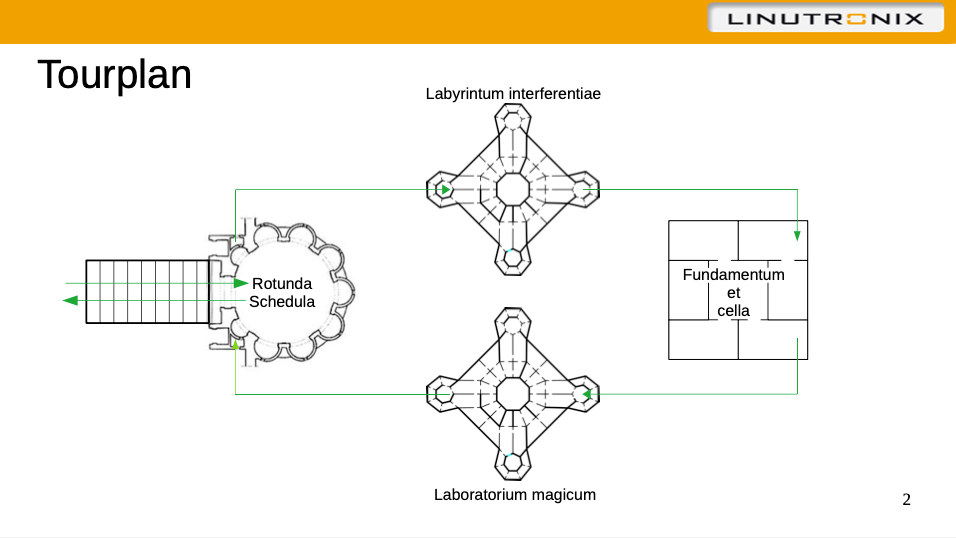
In May, the ELISA Project hosted its 7th Workshop with 239 participants from 37 different countries. For a complete recap of the workshop, click here. Today, we’ll take a look at one of the sessions titled “A Guided Tour Through the PREEMPT RT castle” presented by Thomas Gleixner, CTO at Linutronix GmbH.

The tour through the inner workings of PREEMPT_RT will start at the observation deck to give an conceptual overview. From there it will take the participants through the various chambers which contain a broad range of historic and contemporary operating system technologies. The tour will not only take the hallways it is also going to explore some of the secret passages and the brave-hearted can take a glimpse at the horror cabinets.

General knowledge about operating system concepts is recommended for taking the tour, but of course it’s open for everyone and all chambers have exit doors if it gets too spooky.

ELISA and AUTOSAR Adaptive Brainstorm

By Blog, Workshop

In May, the ELISA Project hosted its 7th Workshop with 239 participants from 37 different countries. For a complete recap of the workshop, click here. Today, we’ll take a look at one of the sessions titled “ELISA and AUTOSAR Adaptive Brainstorm” led by Philipp Ahmann, ADIT GmbH, Huzaifa Saadat, Autosar Experts & Wolfgang Schramm, Continental AG.

AUTOSAR (AUTomotive Open System ARchitecture) is a worldwide development partnership of vehicle manufacturers, suppliers, service providers and companies from the automotive electronics, semiconductor and software industry. The ELISA Project started working more closely with AUTOSAR and Automotive Grade Linux (AGL) and now has a Working Group dedicated to this collaboration.

The AUTOSAR Consortium Working Group Safety works closely with the ELISA Project Automotive Working Group. Previously, the group collaborated to figure out which requirements are put to the system and if assumptions from the Automotive WG can fit with AAUTOSAR expectations. The discussions with AUTOSTAR should harden the work within the ELISA Automotive WG. In this workshop video, Philipp Ahmann, Huzaifa and Wolfgang discuss the work within the ELISA Project, collaboration and host a brainstorm about next steps and more. Watch it here:

Click here learn more about the ELISA Project, here for the Working Groups and here to join our mailing list. 

A Maintainable and Scalable Kernel Qualification Approach for Automotive

By Blog, Workshop

In May, the ELISA Project hosted its 7th Workshop with 239 participants from 37 different countries. For a complete recap of the workshop, click here. Today, we’ll take a look at one of the sessions led by Daniel Bristot de Oliveira, Principal Software Engineer at Red Hat, and Gabriele Paoloni, Senior Software Architect at Intel, titled “A Maintainable and Scalable Kernel Qualification Approach for Automotive.”

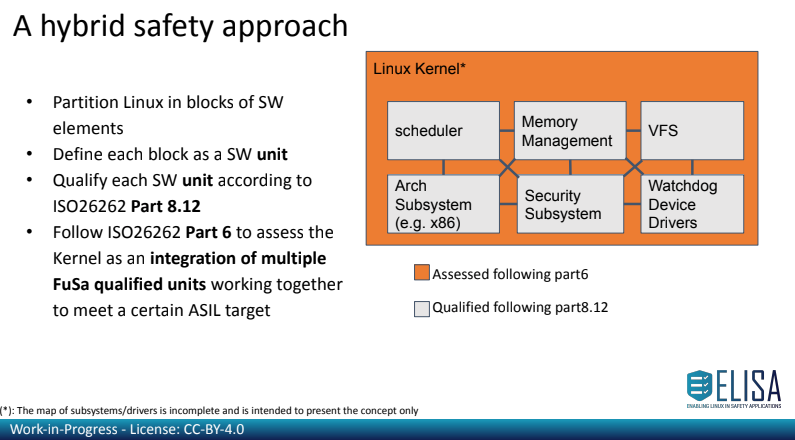
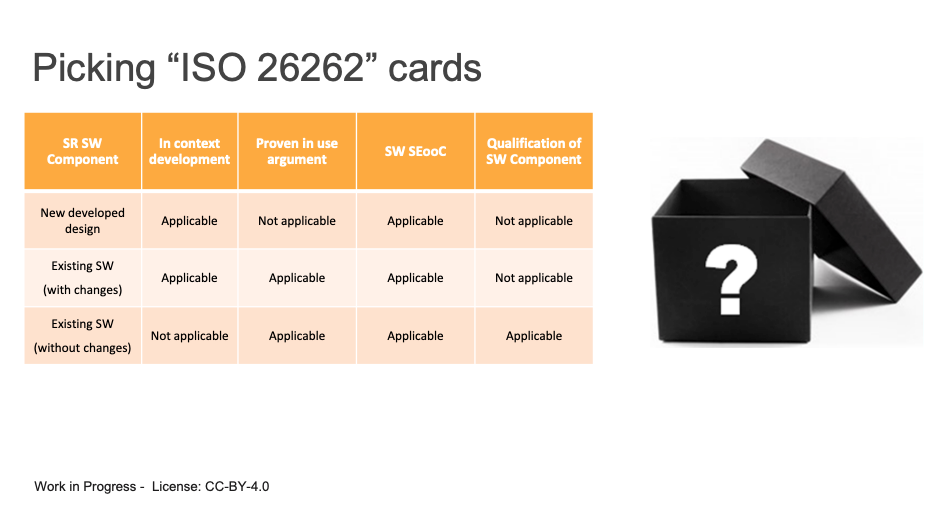
In this presentation, Daniel and Gabriele present an innovative approach that aims for the Functional Safety qualification of Linux by leveraging both ISO26262-6 and ISO26262-8.12.

The goal of this presentation was to get feedback on the approach suitability from a Functional Safety point of view, the approach usability in the current Linux mainline development flow and discuss about the next steps.

If you would like to learn more, Daniel and Gabriele will be giving an updated presentation at Embedded Linux Conference on September 28. Learn more about the session and other ELISA talks here.

ELISA Project Launches Call for Papers for November 8-10 Workshop

By Announcement, Blog, Workshop

Since launching in 2019, the ELISA Project has continued to grow in membership, community contributions and working groups. The project’s more than 20 member companies, which include ADIT, AISIN AW CO., arm, Automotive Grade Linux, BMW Car IT GmbH, Codethink, Elektrobit, Horizon Robotics, Huawei Technologies, Intel, Kuka, Linuxtronix, Mentor, NVIDIA, OTH Regensburg, Red Hat, Suzuki, Toyota and Wind River, collaborate to define and maintain a standardized set of processes and tools that can be integrated into Linux-based, safety-critical systems seeking safety certification.

Today, the ELISA Project is excited to announce that its next technical workshop will take place virtually on November 8-10. The event is free and open to developers, users and contributors of ELISA from around the globe looking to learn, network and collaborate. 

The Call for Papers is now open and accepting submissions that will tackle technical strategies for development and deployment as well as real-world applications and use cases. Submit a speaking proposal by Friday, October 1 here: https://events.linuxfoundation.org/elisa-workshop/program/cfp/. 

The last workshop took place in May with 239 participants from 37 different countries. It featured sessions that showcased working group milestones, open discussions about projects and use cases in automotive and medical. Additionally, this workshop involved more collaboration with adjacent communities, such as Xen, Real Time Linux and AUTOSAR. For a complete recap of the workshop, click here. 

The ELISA Workshops are hosted once a quarter and are focused on education and outreach for new community members, the exchange of ideas and feedback from the linux kernel and safety communities, as well as productive collaboration to make tangible progress toward achieving the mission and goals of the ELISA Project.

Registration for the event is also open. You can register here. 

Linux in Basic Safety Applications

By Blog, Workshop

In May, the ELISA Project hosted its 7th Workshop with 239 participants from 37 different countries. For a complete recap of the workshop, click here. Today, we’ll take a look at one of the sessions led by Jason Smith, Principal Engineer at UL LLC, about the “Linux in Basic Safety Applications.”

Linux is more often being used in applications with safety relevance:

  • Complex safety-related functions necessitating the advantages of an OS, or
  • Complex end application necessitating the advantages of an OS, now being asked to perform one or more basic safety-related functions (for example: voltage, current, temperature monitoring)

In both cases, software used to implement the safety-related functions may be required to conform/comply with applicable functional safety standards.

In this presentation, Jason will discuss linux in basic safety applications, the goals and progress of the white paper the ELISA Project is working on and details about how to get involved.

Click here learn more about the ELISA Project, here for the Working Groups and here to join our mailing list. 

Open Source Software Safety Concept Tooling in Freeplane

By Blog, Workshop

In May, the ELISA Project hosted its 7th Workshop with 239 participants from 37 different countries. For a complete recap of the workshop, click here. Today, we’ll take a look at one of the sessions led by Jochen Kall, Expert Engineer Safety at ITK Engineering on behalf of Toyota about the “Open Source Software Safety Concept Tooling in Freeplane.”

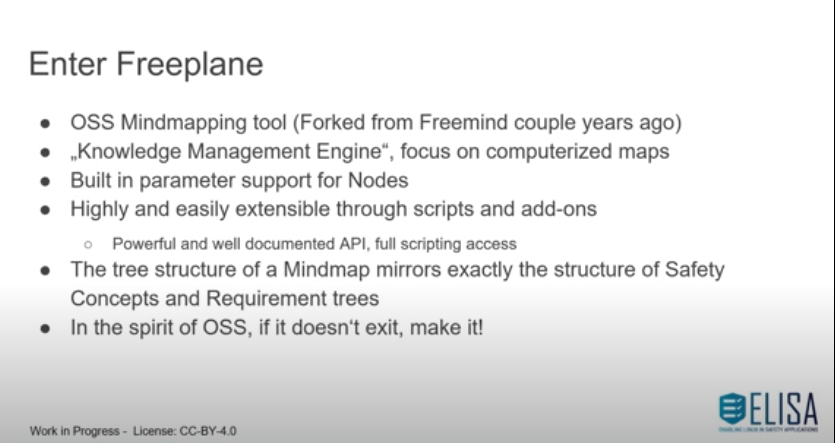
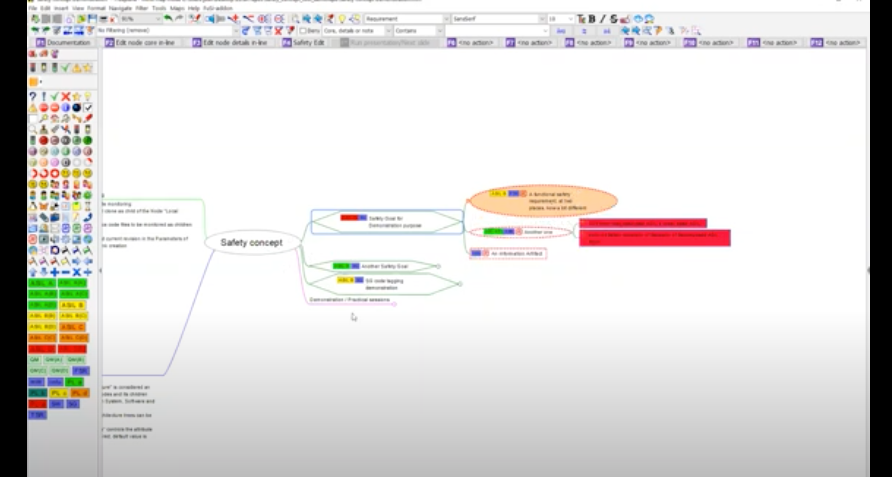
The Automotive Working Group uses an open source software mindmap based tooling for developing and documenting Safety Concepts as well as managing the requirements therein. In this session, an introduction to the tool, its capabilities, and use cases is given, followed by a setup/tutorial session guiding the audience through installation and setup of the tool as well as a demonstration of how it can be used in safety engineering.

Freeplane is available on github ((https://github.com/Jochen-Kall/Safety_concept_tool) and helps Safety/Requirements Engineering tasks with support for:
– Avoiding duplication of repeated requirements, leveraging clones
– Managing artifact types, ASILs ,etc and their respective constraints
– Allocating to architectural elements
– Code tagging
– Safety Consistency checking
– Tainting/Changing Propagation in the tree
– Exporting / Importing [WIP]

Watch the video below and let us know if you have questions!

Click here learn more about the ELISA Project, here for the Working Groups and here to join our mailing list. 

Usability of ISO 26262 2nd Edition for an Open Source Design

By Blog, Workshop

In May, the ELISA Project hosted its 7th Workshop with 239 participants from 37 different countries. For a complete recap of the workshop, click here. Today, we’ll take a look at one of the sessions led by Roberto Paccapeli, Functional Safety Manager at Intel and Vito Magnanimo, Functional Safety Architect at BMW Group, about the “Usability of ISO 26262 2nd Edition for an Open Source Design.”

In the automotive domain, the reference standard for Functional Safety is ISO 26262. The normative does not currently provide a clear distinction between new Software design and pre-existing ones. This limitation directly impacts on open source designs, developed in accordance with non-standardized development process (e.g. Linux operations system). This video presents some of the gaps observed in the standard and introduces hints that can be jointly addressed with ELISA members without losing the cornerstone of the ISO (or in contrast with its clauses).

Click here learn more about the ELISA Project, here for the Working Groups and here to join our mailing list. 

Updates for ELISA’s Tooling Investigation and Code Improvement WorkGroup

By Blog, Workshop

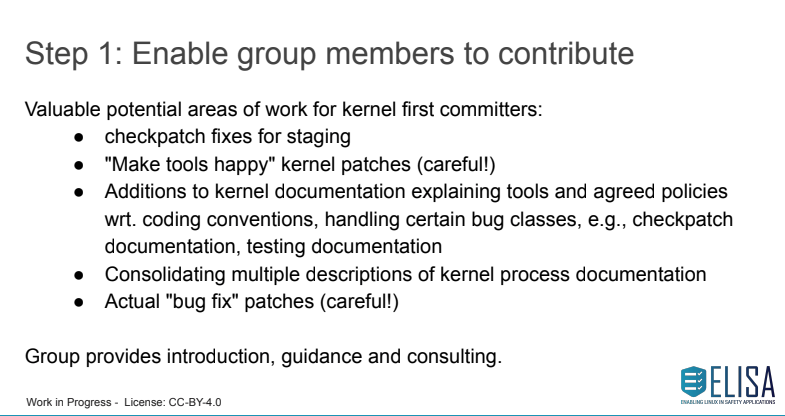
The ELISA Project has several working groups each dedicated to a focus or use case. In today’s blog, we’ll take a look at the Tool Investigation and Code Improvement WorkGroup. The Tool Investigation and Code Improvement WG focuses on application of tools, handling the tool results, and improving the kernel based on the tools’ feedback.

Lukas Bulwhan, Safety Software Key Expert at Elektrobit GmbH, leads the Tool Investigation and Code Improvement WorkGroup and recently gave an update about their mission, achievements and roadmap at the last ELISA Project Workshop. You can watch the presentation below.

ELISA Project Workshop May 2021: Tooling Investigation and Code Improvement Working Group Update

If you have questions or would like to join the Working Group, they meet weekly on Tuesdays. Subscribe to the mail list here: https://lists.elisa.tech/g/tool-investigation.

Xen Project: How we do functional safety

By Blog, Workshop

In May, the ELISA Project hosted its 7th Workshop with 239 participants from 37 different countries. For a complete recap of the workshop, click here. Today, we’ll take a look at one of the sessions led by Artem Mygaiev, Director of Technology Solutions at EPAM Systems, Stefano Stabellini, Principal Engineer at Xilinx, about the Xen Project.

Tailored versions of Xen Hypervisor are used in mission-critical systems for years, but this was never the case for Xen’s mainline. Starting 2019, Special Interest Group in Xen Project works on identifying and eliminating obstacles on the way to safety-certify Xen. In this video, Artem and Stefano will talk about their approach, progress so far and collaboration with other groups within Linux Foundation.

Click here learn more about the ELISA Project, here for the Working Groups and here to join our mailing list.