
On May 13, 2026, the ELISA Project hosted a seminar exploring how open source technologies including Xen, Zephyr RTOS, and Linux are advancing toward deployment in safety-critical systems across avionics, automotive, and industrial domains.
The session featured Ayan Kumar Halder (AMD) and Matthew Weber (Boeing), who shared ongoing collaborative work around functional safety, mixed-criticality systems, and open source safety certification efforts.
The discussion focused on how Xen, Zephyr, and Linux can be composed into a unified architecture for safety-critical environments. The speakers outlined how Xen can act as a Type-1 hypervisor, isolating workloads with different safety requirements while supporting deterministic execution, static partitioning, and freedom from interference between virtual machines.
A major theme throughout the session was the growing collaboration between the Xen community and the ELISA Project to build an open functional safety ecosystem. The work spans multiple safety standards including ISO 26262, IEC 61508, and DO-178C, with the goal of creating reusable safety certification artifacts and methodologies that can benefit multiple industries.
The seminar highlighted several ongoing technical efforts within the Xen functional safety initiative, including:
- MISRA C compliance improvements and automated CI checking
- MPU support for ARM Cortex-R systems
- Static partitioning and deterministic scheduling
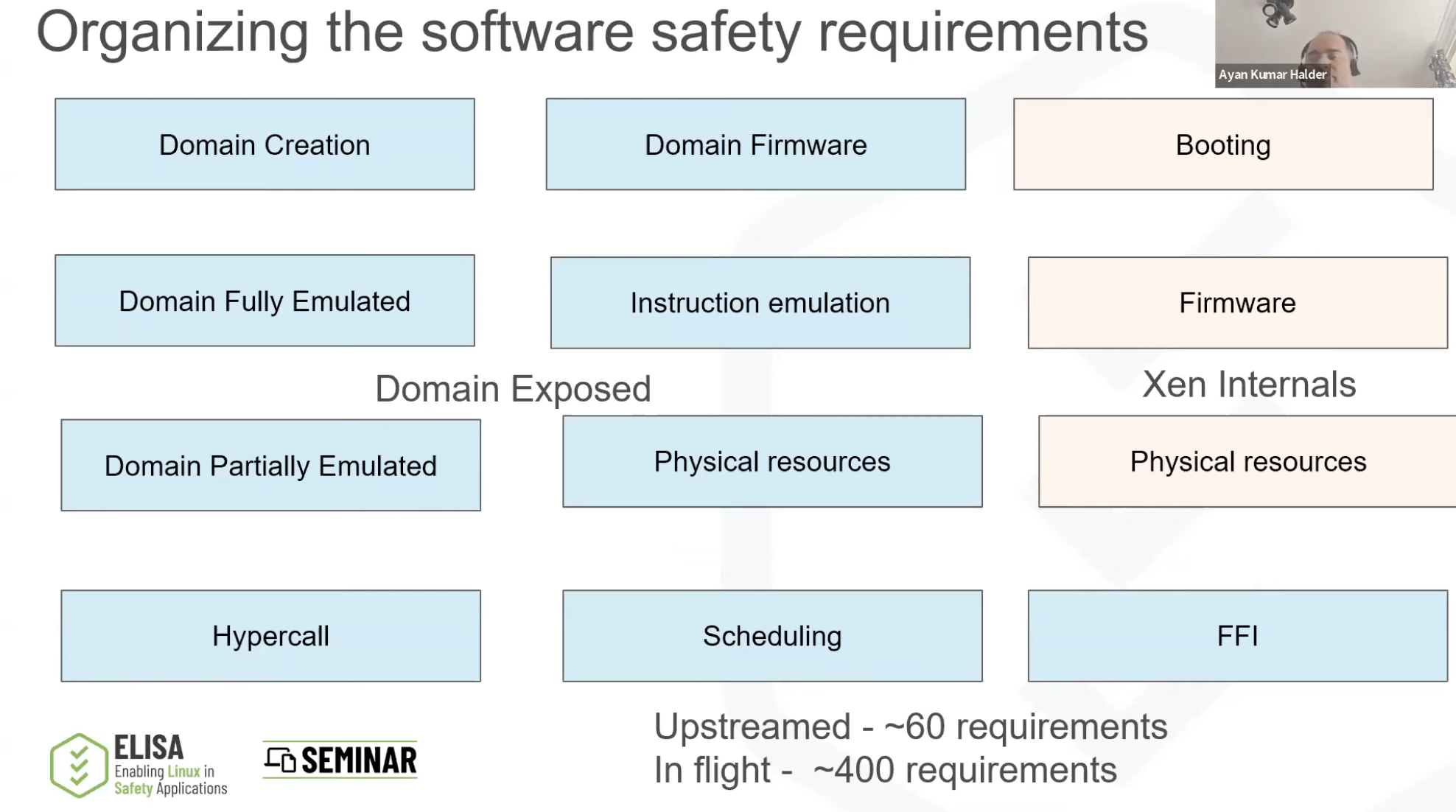
- Requirements traceability and architecture specifications
- Domain-based testing, fault injection, fuzzing, and unit testing
- White-box testing approaches using Ceedling and coverage analysis
- Open source traceability workflows using Open Fast Trace
The speakers also discussed the importance of defining assumptions of use (AoU) between system components such as firmware, hypervisors, operating systems, and applications. This systems-level perspective is critical for enabling Linux and Xen to operate within certified safety environments.
Matthew Weber shared additional insights from the aerospace domain, explaining how avionics standards such as DO-178C and ARINC 653 complement ongoing automotive safety efforts. The session explored how higher levels of testing rigor, deterministic partitioning, and lifecycle traceability can help support mixed-criticality aerospace systems using open source technologies.
Another key discussion point was sustainability. Functional safety is not a one-time activity but an ongoing engineering process that must evolve alongside code changes, new features, and emerging defects. The speakers emphasized the importance of open collaboration, transparent development processes, and community participation to keep safety-related artifacts and testing continuously maintained.
The session concluded with an invitation for the broader community to get involved through mailing lists, workshops, Git repositories, and upcoming events including the Xen Summit and ELISA workshops.
As open source continues expanding into regulated and safety-critical industries, collaborations like these are helping create the technical foundations, tooling, and community processes needed to support the next generation of safety-focused systems.
Watch for upcoming ELISA seminars and community workshops to continue the conversation around functional safety, mixed-criticality systems, and open source collaboration.
Upcoming ELISA Seminars: