

How can Linux, Zephyr, and virtualization technologies work together in safety-critical systems?
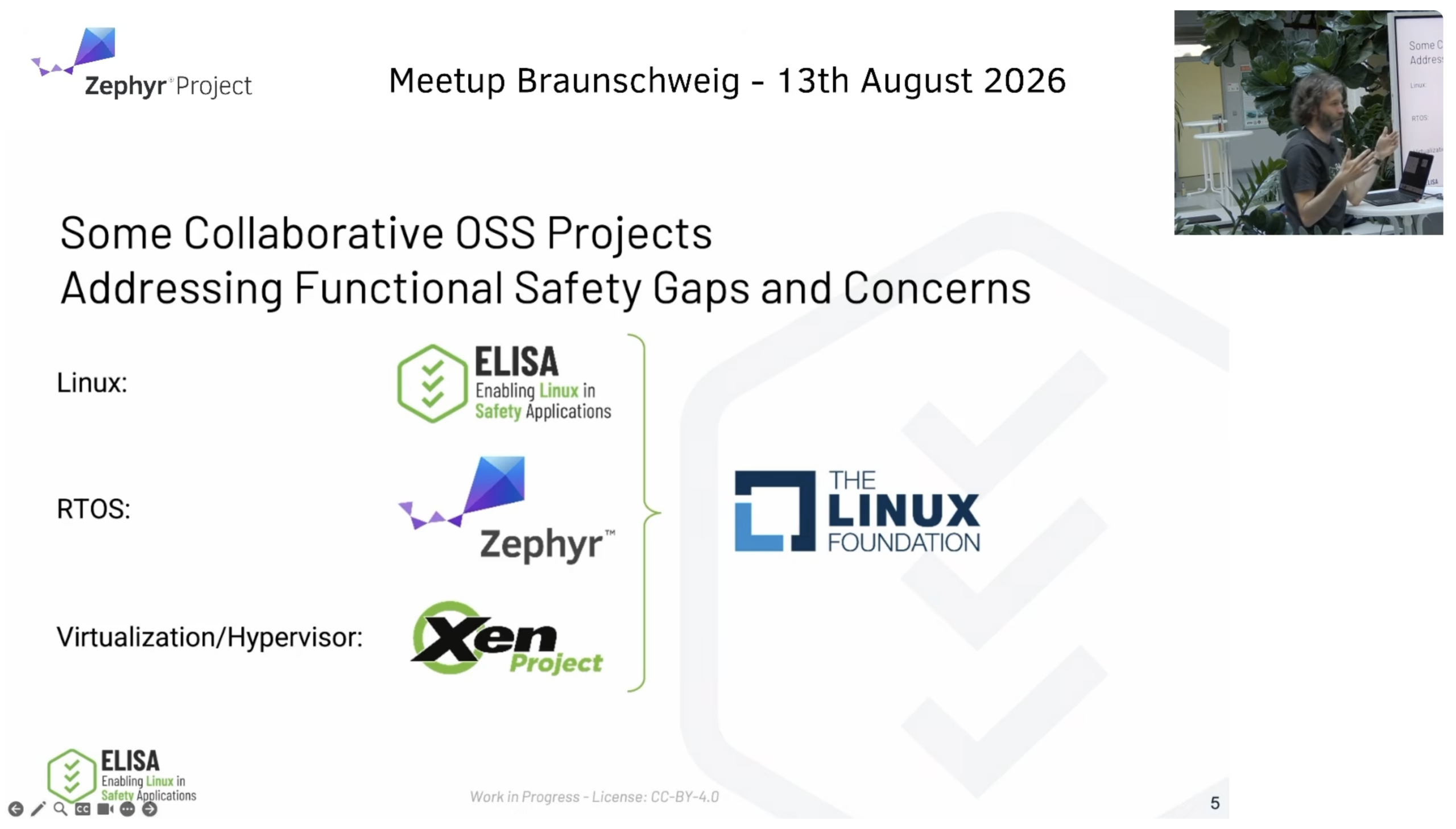
At the Zephyr Project Meetup in Braunschweig, Germany, on August 13, 2026, Philipp Ahmann, Chair of the ELISA Project Technical Steering Committee and lead of its Systems Working Group, discussed how different open source technologies can complement each other within larger system architectures.
The session highlighted the work of the Enabling Linux in Safety Applications (ELISA) Project to support the development of dependable Linux-based systems across industries, including automotive, aerospace, medical devices, and railways. Philipp explained the challenges of applying functional safety standards to complex open source systems, particularly around requirements, traceability, architecture, and implementation. He emphasized that ELISA does not aim to deliver a safety-certified Linux distribution but instead works on tools, processes, and approaches that can help organizations use Linux in safety-critical applications.
A key focus of the presentation was the ELISA Systems Working Group’s work on system architectures that combine Linux with real-time operating systems (RTOS) and virtualization technologies. Philipp discussed different architectural approaches, explaining how Zephyr can take on real-time and control tasks while Linux provides broader hardware and driver support.
He also introduced the ELISA example system, which runs Linux and Zephyr in separate domains using the Xen hypervisor. The demonstrator was developed to explore these mixed architectures and is also available in a QEMU-based environment. However, maintaining a dedicated demonstrator and its supporting infrastructure has presented challenges. To address this, ELISA is working toward adopting the Automotive Grade Linux (AGL) Software Defined Vehicle (SoDeV) environment, which uses a similar Xen-based architecture. This collaboration would allow ELISA to focus more on safety-related requirements and approaches while building on AGL’s existing development and integration infrastructure.
The presentation also explored how similar system architectures are emerging across automotive, avionics, and railway applications. Philipp highlighted discussions between these communities, including growing interest from ELISA’s Railways Special Interest Group (SIG) in using an example system to explore railway-specific applications. These activities offer opportunities to share technical approaches and avoid duplicating development efforts across industries.
During the Q&A, Philipp addressed the challenges of bringing open source technologies into commercial safety-critical applications. The discussion covered the need for safety documentation, long-term support, and the role of commercial providers in building products on top of open source foundations. He also highlighted how a broader ecosystem of providers could help organizations reduce vendor lock-in while maintaining and evolving their systems.
The session emphasized the importance of considering the complete system rather than focusing on a single operating system or software component. Through its Systems Working Group and collaboration with projects such as Zephyr, Xen, and AGL, ELISA continues to explore how open source technologies can be combined and supported for use in safety-critical systems.