
On February 11–12, the ELISA Project community gathered for the 2026 Working Group (WG) and Special Interest Group (SIG) Annual Updates. Over two focused sessions, group leads shared key milestones from 2025, current technical priorities, and what lies ahead in 2026, along with concrete opportunities for collaboration and contribution.
The annual updates serve as a checkpoint for the project: a moment to reflect on progress, align on priorities, and welcome new contributors into the work of advancing Linux in safety-critical systems.
This week we highlight the session on ELISA Lighthouse Special Interests Group presented by Philipp Ahmann, ETAS.
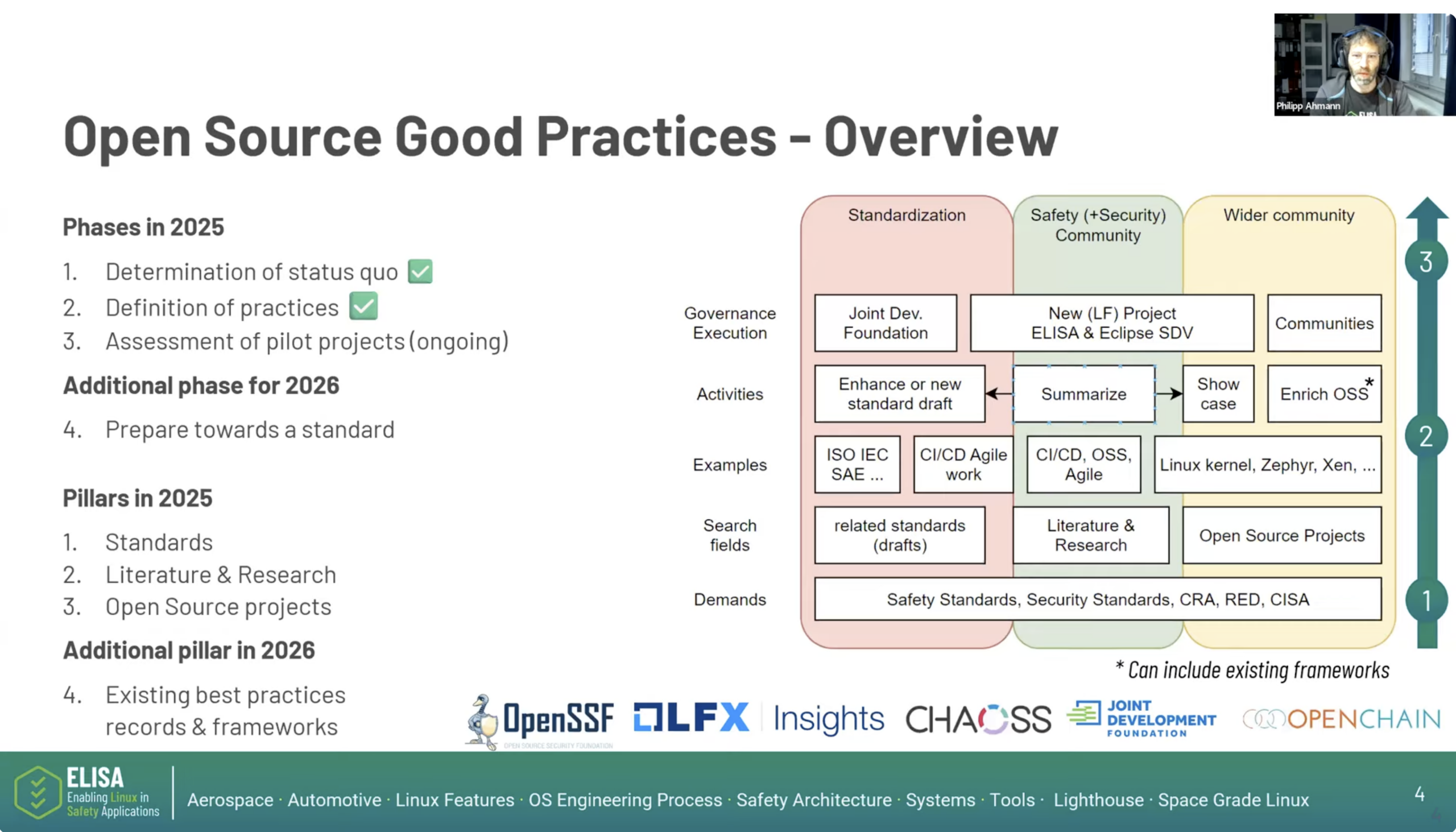
The Lighthouse SIG focuses on best practices for open source software in safety-critical systems. Philipp explained that many existing quality and safety standards were designed for proprietary software development, while open source communities often work through code-first, CI-driven, and agile processes. The group is exploring how established open source practices can be evaluated, documented, and eventually shaped into guidance or a standard that regulated industries can use.
In 2025, the SIG worked to understand the current landscape. The group reviewed existing safety, quality, and security standards, conducted literature research, and began assessing open source projects. Early work included creating a template to evaluate process robustness and evidence confidence across different criteria. Initial project assessments included Yocto, Xen, and LLVM, with plans to expand to projects such as Linux, curl, and OpenSSL.
The session also highlighted collaboration with other communities, including Eclipse automotive efforts, CHAOSS, OpenSSF Scorecard, LFX Insights, OpenSSF Best Practices, OpenChain, and the Joint Development Foundation. The goal is to avoid duplication, learn from existing work, and align with broader open source and standards communities.
Looking ahead to 2026, the Lighthouse SIG plans to refine its maturity model, review more projects, evaluate existing badges and scorecards, and continue preparing for possible standards work. The group is also exploring how to define and measure quality in open source projects more clearly.
Philipp closed by inviting new contributors to join the Lighthouse SIG. The group meets every other Friday and welcomes participation through its meetings, mailing list, Discord channel, GitHub repository, and meeting minutes.
Watch the full session to learn how the Lighthouse SIG is progressing and how you can get involved.