
The ELISA Project community gathered at Canonical’s London office from June 9–11, 2026, for three days of technical presentations, discussions, and collaboration focused on advancing Linux for safety-critical applications.
The workshop included updates to BASIL, the introduction of the Railways Special Interest Group (SIG), and discussions on approaches to enabling Linux in safety applications. The main topics included requirements mapping, test traceability, railway-specific safety requirements, managing interference with safety functions, and developing reusable resources to support system-specific safety arguments.
In this blog from our post-event series, we highlight three sessions covering these topics. The first presented BASIL’s latest features and planned developments, including Jumpstarter integration, support for the proposed SPDX 3.1 safety profile, and AI-assisted workflows. The second introduced the Railways SIG’s mission to represent railway industry needs within ELISA, alongside plans to collect applicable software requirements and develop an open source proof-of-concept project. The third explored defining Linux’s responsibilities within a system, detecting and mitigating potential interference, and helping integrators build safety cases through shared guidance, processes, analysis artifacts, and practical examples.
BASIL The FuSa Spice – Luigi Pellecchia, Red Hat
Luigi Pellecchia of Red Hat presented updates to BASIL, ELISA’s open source quality-management platform for requirements mapping, test traceability, and compliance documentation. He reviewed new features, including PDF and HTML exports, hierarchical document mappings, forking and deletion of work items, automatic repair of broken mappings, folder-based file organization, and comments marked as to-do items. A demonstration showed how the new dynamic mapping view helped users identify relationships between sections of source code and associated requirements, test cases, and test specifications.
Luigi also outlined the roadmap for future development, including Jumpstarter integration for test execution, support for the proposed SPDX 3.1 safety profile, and an MCP server and skills to support AI-assisted interactions with BASIL. He discussed challenges in representing how a group of work items collectively described a reference document and encouraged community contributions and further tooling discussions. Slides here.
Railways SIG Introduction – Henrik Brändle, Institute for Rail Vehicles, RWTH Aachen University
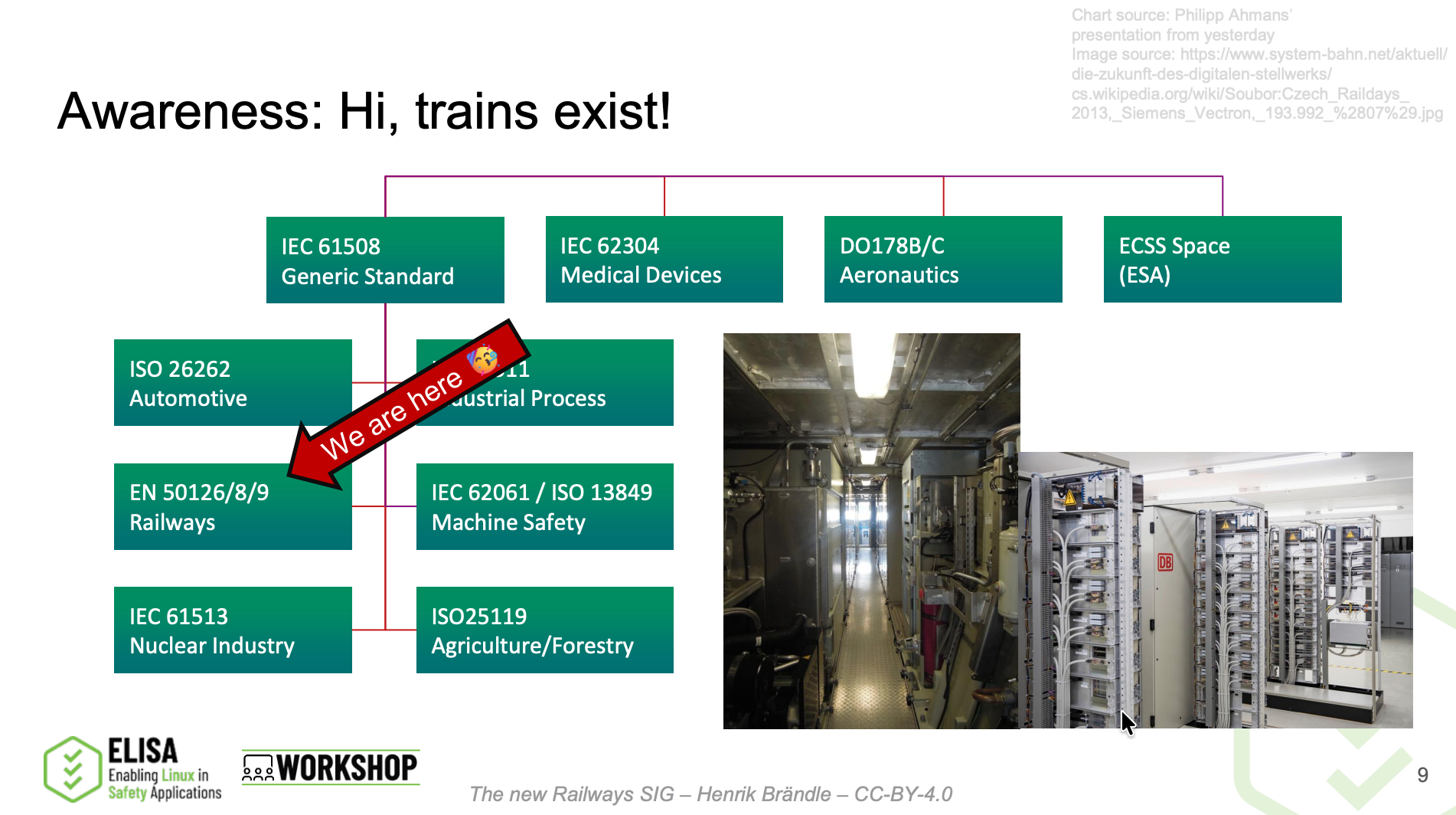
Henrik Brändle of the Institute for Rail Vehicles at RWTH Aachen University introduced the newly established ELISA Railways Special Interest Group (SIG) and its mission to represent the needs of safety-critical railway systems within ELISA. He described the group’s collaboration across rolling stock and signaling system manufacturers, railway operators, certification bodies, consultants, and universities. The session highlighted railway-specific safety requirements and the SIG’s role as a central contact point to help other ELISA groups make their tools and approaches applicable to the railway industry.
Henrik outlined plans to collect applicable railway software requirements in an open repository and develop a public proof-of-concept project demonstrating what could be achieved with open source software. He discussed building on the Systems Working Group’s work and using tools such as BASIL to create safety artifacts aligned with railway standards. He also encouraged participation from additional stakeholders, particularly those outside Europe, to broaden the group’s understanding of different railway requirements and standards. Slides here.
What overall approach to enable Linux in safety applications can we recommend? – Paul Albertella, Codethink; Igor Stoppa, NVIDIA; Pete Brink, UL Solutions
Paul Albertella of Codethink, Igor Stoppa of NVIDIA, and Pete Brink of UL Solutions discussed approaches to enabling Linux in safety applications, drawing on ELISA’s Open Source Engineering Process Working Group discussions. The session emphasized that safety needed to be assessed within a specific system context and that Linux’s widespread use alone did not establish a safety argument. The speakers explored minimizing Linux’s responsibilities, analyzing potential interference with safety functions, and incorporating independent detection and mitigation mechanisms.
The discussion examined approaches involving hypervisors, selected qualified kernel components, and user-space monitoring, including challenges around visibility, independence, completeness, and system availability. It also addressed the impact of software updates and long-term maintenance on safety arguments. Participants explored how ELISA could support integrators through documented limitations, reusable guidance, processes, analysis artifacts, and practical examples. They highlighted collaboration across working groups and other open source projects, as well as the need to improve shared understanding between developers and safety assessors, to help integrators build safety cases for their own systems. Slides here.
These three sessions highlighted how tooling, industry-specific requirements, and system-level analysis contributed to ELISA’s work on enabling Linux in safety applications. BASIL’s updates supported requirements mapping and test traceability, while the Railways SIG outlined plans to bring railway needs into shared community efforts. The broader discussion emphasized the importance of understanding Linux’s role within each system and providing reusable resources to help integrators develop their own safety arguments.
Explore the recordings and slides above to learn more about these discussions and opportunities to contribute to ELISA’s tools, working groups, and Railways SIG.