

The ELISA Project community gathered at Canonical’s London office from June 9–11, 2026, for three days of technical presentations, discussions, and collaboration focused on advancing Linux for safety-critical applications.
The workshop included discussions on the opportunities and challenges of using AI-based tools in safety-related development. Topics included requirements and test development, static code analysis for the Linux kernel, tool classification and qualification, risk analysis, explainability, false results, and human oversight.
In this blog from our post-event series, we highlight three sessions focused on AI-based tooling. The first introduced possible uses of AI throughout the development lifecycle and considered how different markets were addressing qualification and regulatory challenges. The second presented a work-in-progress approach for using AI to classify and prioritize large numbers of static code analysis violations in the Linux kernel. The third described NVIDIA’s methodology for introducing AI into safety-critical product development, beginning with AI-assisted reviewers and working toward controlled generation workflows.
Introduction: AI based tooling used during a project development lifecycle and different market views – Olivier Charrier, Wind River
Olivier Charrier of Wind River introduced the potential value of AI-based tools in safety-related development. He discussed how AI could help process large amounts of data, derive and review requirements from existing source code, and generate tests against requirements. The session also examined the challenges of qualifying AI tools, including their probabilistic behavior, training data, false positives and negatives, and the ability to explain their results. Charrier noted that while AI could support preliminary analysis and help identify issues in code or tests, human involvement remained necessary to complete the formal work required by current safety regulations. The session concluded by opening a discussion about how different markets were addressing these challenges. Slides here.
Taming the Violation Tsunami: Using AI to Tailor Static Code Analysis for Safe Linux – Eli Gurvitz, NVIDIA
Eli Gurvitz of NVIDIA presented a work-in-progress approach for using AI to analyze the large number of static code analysis violations found in the Linux kernel. The proposed process classified each violation as deviated, unknown, or a potential issue. Potential issues could then be prioritized and tested to determine whether they represented real bugs. The session also covered creating deviation records, using permits for recurring violations, grading coding rules, and addressing potential issues through safety analysis, assumptions of use, manual inspection, additional verification, or code fixes. Examples showed how a violation might be harmless in one Linux version but require reevaluation when the code changes, as well as how AI-assisted analysis identified a real vulnerability. The session concluded by raising the unresolved question of how AI results could be trusted in safety-critical development. Slides here.
Applying AI to safety-critical product development – Nicola Di Miscio, NVIDIA; Francesco Saracino, NVIDIA
Nicola Di Miscio presented NVIDIA’s approach to adopting AI in safety-critical product development, based on work carried out with Francesco Saracino. Rather than attempting to make AI deterministic, the methodology used established safety and cybersecurity processes, workflows, roles, and review gates to contain its probabilistic behavior. NVIDIA began at the requirements level, using AI as a reviewer rather than allowing it to generate or autonomously modify approved artifacts. The session covered standardizing input data, reviewing requirements for quality and consistency, reducing false negatives, maintaining human oversight, and recording review decisions. It also examined tool classification and qualification management, risk and impact analysis, and controls applied within both the tool and the wider development process. This reviewer-first approach was presented as a foundation for introducing controlled AI-generated content in the future, with humans continuing to approve the final artifacts. Slides here.
These sessions showed how AI-based tools could support requirements analysis, test development, and the review of large numbers of static code analysis violations. They also presented approaches for identifying potential bugs, prioritizing findings, and improving the efficiency of safety-related development activities.
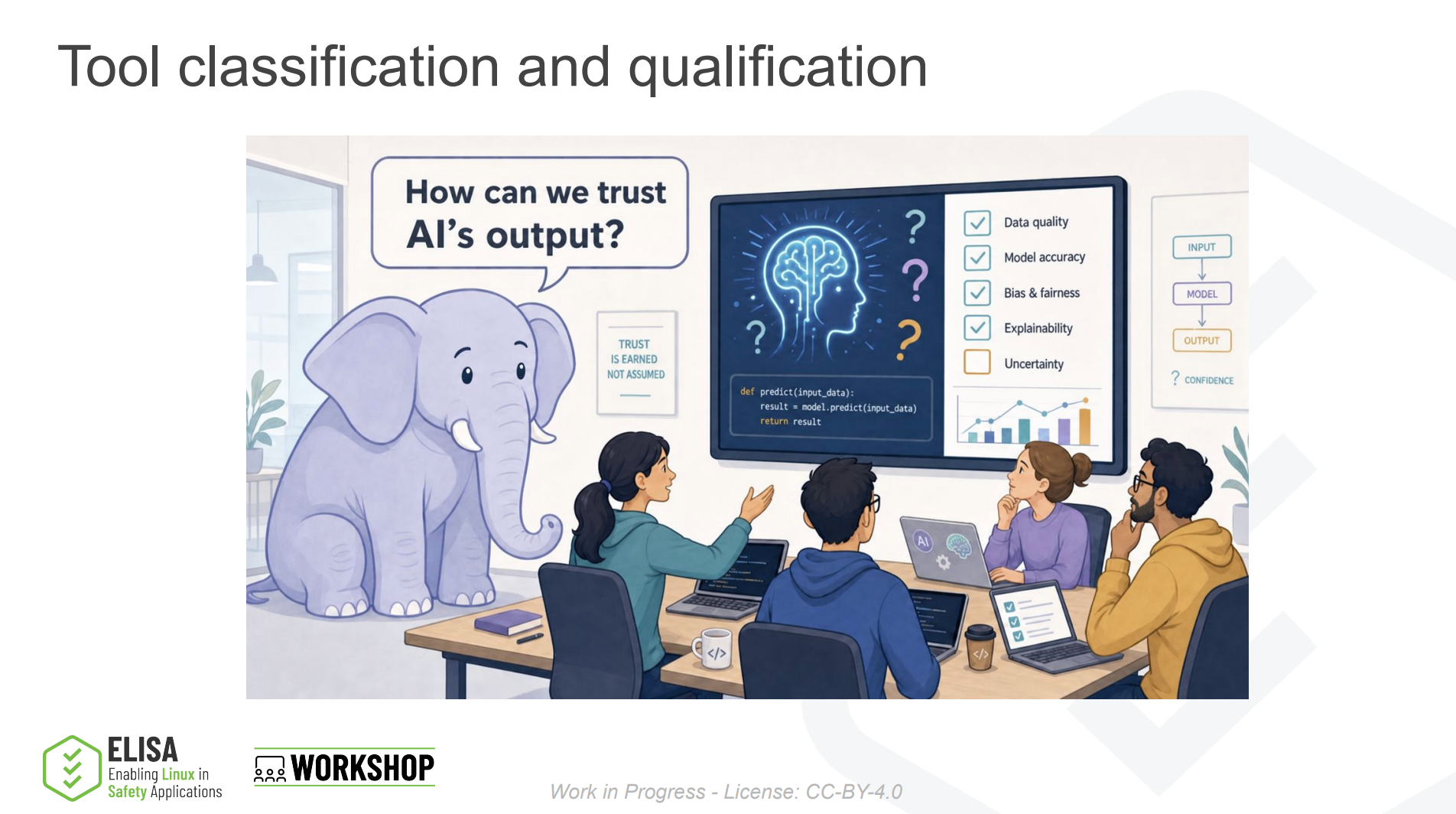
The discussions highlighted that using AI in safety-critical development still raises important questions about probabilistic results, training, explainability, false positives and negatives, tool qualification, and trust. The sessions emphasized the continued need for human review, established development processes, risk analysis, and appropriate controls when applying AI to safety-related work.
The next blog in this series will highlight more sessions from the ELISA Workshop London 2026. Stay tuned!