
On February 11–12, the ELISA Project community gathered for the 2026 Working Group (WG) and Special Interest Group (SIG) Annual Updates. Over two focused sessions, group leads shared key milestones from 2025, current technical priorities, and what lies ahead in 2026, along with concrete opportunities for collaboration and contribution.
The annual updates serve as a checkpoint for the project: a moment to reflect on progress, align on priorities, and welcome new contributors into the work of advancing Linux in safety-critical systems.
This week we highlight the session on BASIL & Tools Working Group Evolution.
In this session from the ELISA Project Annual Updates, Luigi Pellecchia presents a recap of the BASIL tool’s development in 2025 and outlines planned directions for 2026. BASIL is described as a collaborative, web-based tool for traceability management, supporting multi-user environments, granular permissions, and detailed relationships between code, requirements, and test artifacts. It also integrates with internal and external test infrastructures and provides multiple export formats, including SPDX, HTML, and PDF.
The 2025 update highlights incremental improvements across the year, including enhancements to AI-assisted features, user experience refinements, support for importing external work items, and expanded browser compatibility. Infrastructure improvements include container optimization, security fixes, integration with additional testing frameworks, and the introduction of API code coverage monitoring. A major architectural change was the migration from SQLite to PostgreSQL to better support concurrent usage.
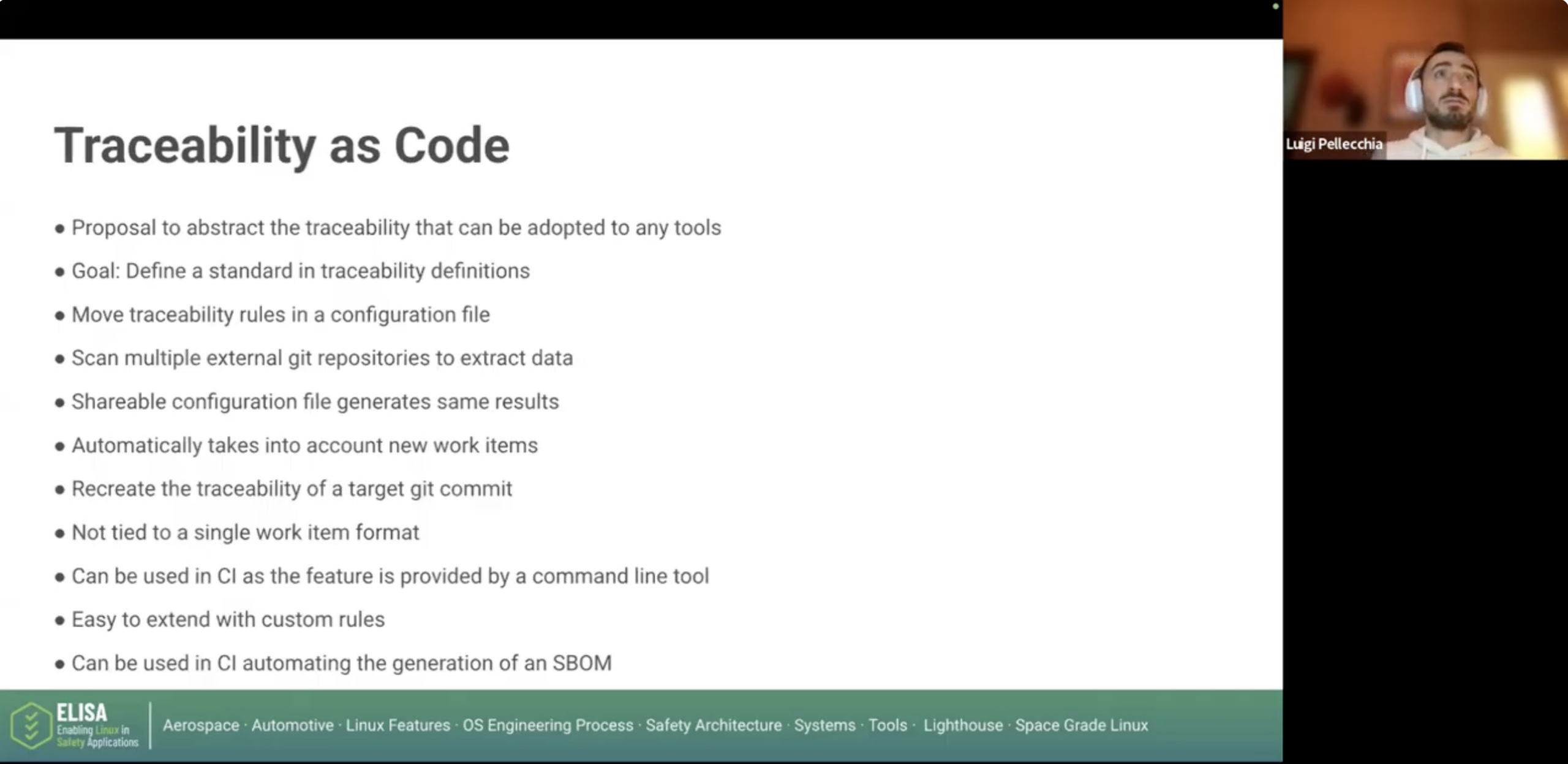
A key development in late 2025 is the introduction of “traceability as code,” an initial proposal to define traceability relationships through configuration files, enabling connections between distributed artifacts such as source code, test cases, and test results across different repositories and systems.
Looking ahead to 2026, planned efforts include extending traceability features (e.g., linking test results), introducing baseline snapshots of traceability states, improving test coverage, and continuing iterative development based on community feedback. The session also highlights available resources such as a public BASIL instance, documentation, and communication channels, and encourages community participation in both BASIL and the broader Tools Working Group.
Overall, the session focuses on the progress, ongoing development, and open collaboration around tooling to support traceability in safety-critical Linux environments.