

This blog is written by Alessandro Carminati, Principal Software Engineer at Red Hat and lead for the ELISA Project’s Linux Features for Safety-Critical Systems (LFSCS) WG.
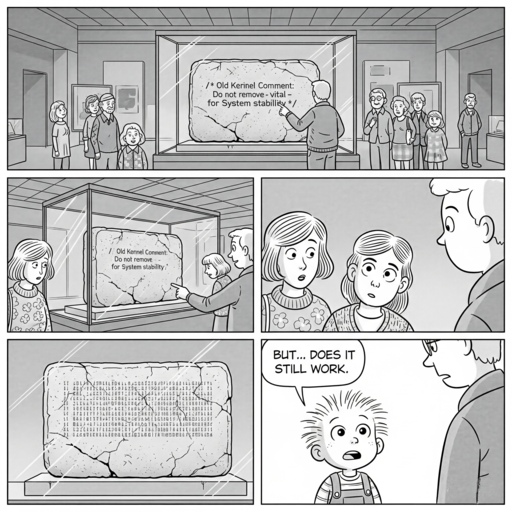
As part of the ELISA community, we spend a good chunk of our time spelunking through the Linux kernel codebase. It’s like code archeology: you don’t always find treasure, but you _do_ find lots of comments left behind by developers from the ’90s that make you go, “Wait… really?”
One of the ideas we’ve been chasing is to make kernel comments a bit smarter: not only human-readable, but also machine-readable. Imagine comments that could be turned into tests, so they’re always checked against reality. Less “code poetry from 1993”, more “living documentation”.
Speaking of code poetry, [here] one gem we stumbled across in `mem.c`:
```
/* The memory devices use the full 32/64 bits of the offset,
 * and so we cannot check against negative addresses: they are ok.
 * The return value is weird, though, in that case (0).
 */
 ```
This beauty has been hanging around since **Linux 0.99.14**… back when Bill Clinton was still president-elect, “Mosaic” was the hot new browser,
and PDP-11 was still produced and sold.
Back then, it made sense, and reflected exactley what the code did.
Fast-forward thirty years, and the comment still kind of applies…
but mostly in obscure corners of the architecture zoo.
On the CPUs people actually use every day?
```
$ cat lseek.asm
BITS 64

%define SYS_read    0
%define SYS_write   1
%define SYS_open    2
%define SYS_lseek   8
%define SYS_exit   60

; flags
%define O_RDONLY    0
%define SEEK_SET    0

section .data
    path:    db "/dev/mem",0
section .bss
    align 8
    buf:     resq 1

section .text
global _start
_start:
    mov     rax, SYS_open
    lea     rdi, [rel path]
    xor     esi, esi
    xor     edx, edx
    syscall
    mov     r12, rax        ; save fd in r12

    mov     rax, SYS_lseek
    mov     rdi, r12
    mov     rsi, 0x8000000000000001
    xor     edx, edx
    syscall

    mov     [rel buf], rax

    mov     rax, SYS_write
    mov     edi, 1
    lea     rsi, [rel buf]
    mov     edx, 8
    syscall

    mov     rax, SYS_exit
    xor     edi, edi
    syscall
$ nasm -f elf64 lseek.asm -o lseek.o
$ ld lseek.o -o lseek
$ sudo ./lseek| hexdump -C
00000000  01 00 00 00 00 00 00 80                           |........|
00000008
$ # this is not what I expect, let's double check
$ sudo gdb ./lseek
GNU gdb (Fedora Linux) 16.3-1.fc42
Copyright (C) 2024 Free Software Foundation, Inc.
License GPLv3+: GNU GPL version 3 or later <http://gnu.org/licenses/gpl.html>
This is free software: you are free to change and redistribute it.
There is NO WARRANTY, to the extent permitted by law.
Type "show copying" and "show warranty" for details.
This GDB was configured as "x86_64-redhat-linux-gnu".
Type "show configuration" for configuration details.
For bug reporting instructions, please see:
<https://www.gnu.org/software/gdb/bugs/>.
Find the GDB manual and other documentation resources online at:
    <http://www.gnu.org/software/gdb/documentation/>.

For help, type "help".
Type "apropos word" to search for commands related to "word"...
Reading symbols from ./lseek...
(No debugging symbols found in ./lseek)
(gdb) b _start
Breakpoint 1 at 0x4000b0
(gdb) r
Starting program: /tmp/lseek

Breakpoint 1, 0x00000000004000b0 in _start ()
(gdb) x/30i $pc
=> 0x4000b0 <_start>:   mov    $0x2,%eax
   0x4000b5 <_start+5>: lea    0xf44(%rip),%rdi        # 0x401000
   0x4000bc <_start+12>:        xor    %esi,%esi
   0x4000be <_start+14>:        xor    %edx,%edx
   0x4000c0 <_start+16>:        syscall
   0x4000c2 <_start+18>:        mov    %rax,%r12
   0x4000c5 <_start+21>:        mov    $0x8,%eax
   0x4000ca <_start+26>:        mov    %r12,%rdi
   0x4000cd <_start+29>:        movabs $0x8000000000000001,%rsi
   0x4000d7 <_start+39>:        xor    %edx,%edx
   0x4000d9 <_start+41>:        syscall
   0x4000db <_start+43>:        mov    %rax,0xf2e(%rip)        # 0x401010
   0x4000e2 <_start+50>:        mov    $0x1,%eax
   0x4000e7 <_start+55>:        mov    $0x1,%edi
   0x4000ec <_start+60>:        lea    0xf1d(%rip),%rsi        # 0x401010
   0x4000f3 <_start+67>:        mov    $0x8,%edx
   0x4000f8 <_start+72>:        syscall
   0x4000fa <_start+74>:        mov    $0x3c,%eax
   0x4000ff <_start+79>:        xor    %edi,%edi
   0x400101 <_start+81>:        syscall
   0x400103:    add    %al,(%rax)
   0x400105:    add    %al,(%rax)
   0x400107:    add    %al,(%rax)
   0x400109:    add    %al,(%rax)
   0x40010b:    add    %al,(%rax)
   0x40010d:    add    %al,(%rax)
   0x40010f:    add    %al,(%rax)
   0x400111:    add    %al,(%rax)
   0x400113:    add    %al,(%rax)
   0x400115:    add    %al,(%rax)
(gdb) b *0x4000c2
Breakpoint 2 at 0x4000c2
(gdb) b *0x4000db
Breakpoint 3 at 0x4000db
(gdb) c
Continuing.

Breakpoint 2, 0x00000000004000c2 in _start ()
(gdb) i r
rax            0x3                 3
rbx            0x0                 0
rcx            0x4000c2            4194498
rdx            0x0                 0
rsi            0x0                 0
rdi            0x401000            4198400
rbp            0x0                 0x0
rsp            0x7fffffffe3a0      0x7fffffffe3a0
r8             0x0                 0
r9             0x0                 0
r10            0x0                 0
r11            0x246               582
r12            0x0                 0
r13            0x0                 0
r14            0x0                 0
r15            0x0                 0
rip            0x4000c2            0x4000c2 <_start+18>
eflags         0x246               [ PF ZF IF ]
cs             0x33                51
ss             0x2b                43
ds             0x0                 0
es             0x0                 0
fs             0x0                 0
gs             0x0                 0
fs_base        0x0                 0
gs_base        0x0                 0
(gdb) # fd is just fine rax=3 as expected.
(gdb) c
Continuing.

Breakpoint 3, 0x00000000004000db in _start ()
(gdb) i r
rax            0x8000000000000001  -9223372036854775807
rbx            0x0                 0
rcx            0x4000db            4194523
rdx            0x0                 0
rsi            0x8000000000000001  -9223372036854775807
rdi            0x3                 3
rbp            0x0                 0x0
rsp            0x7fffffffe3a0      0x7fffffffe3a0
r8             0x0                 0
r9             0x0                 0
r10            0x0                 0
r11            0x246               582
r12            0x3                 3
r13            0x0                 0
r14            0x0                 0
r15            0x0                 0
rip            0x4000db            0x4000db <_start+43>
eflags         0x246               [ PF ZF IF ]
cs             0x33                51
ss             0x2b                43
ds             0x0                 0
es             0x0                 0
fs             0x0                 0
gs             0x0                 0
fs_base        0x0                 0
gs_base        0x0                 0
(gdb) # According to that comment, rax should have been 0, but it is not.
(gdb) c
Continuing.
�[Inferior 1 (process 186746) exited normally]
(gdb)
```
Not so much. Seeking at `0x8000000000000001`…
Returns `0x8000000000000001` not `0` as anticipated in the comment.
We’re basically facing the kernel version of that “Under Construction”
GIF on websites from the 90s, still there, but mostly just nostalgic
decoration now.
## The Mysterious Line in `read_mem`
Let’s zoom in on one particular bit of code in [`read_mem`](https://elixir.bootlin.com/linux/v6.17-rc2/source/drivers/char/mem.c#L82):
```
	phys_addr_t p = *ppos;
	/* ... other code ... */
	if (p != *ppos) return  0;
```
At first glance, this looks like a no-op; why would `p` be different from
`*ppos` when you just copied it?
It’s like testing if gravity still works by dropping your phone…
**spoiler: it does.**
But as usual with kernel code, the weirdness has a reason.
## The Problem: Truncation on 32-bit Systems
Here’s what’s going on:
– `*ppos` is a `loff_t`, which is a 64-bit signed integer.
– `p` is a `phys_addr_t`, which holds a physical address.
On a 64-bit system, both are 64 bits wide. Assignment is clean, the check
always fails (and compilers just toss it out).
But on a 32-bit system, `phys_addr_t` is only 32 bits. Assign a big 64-bit
offset to it, and **boom**, the top half vanishes.
Truncated, like your favorite TV series canceled after season 1.
That `if (p != *ppos)` check is the safety net.
It spots when truncation happens and bails out early, instead of letting
some unlucky app read from la-la land.
## Assembly Time: 64-bit vs. 32-bit
On 64-bit builds (say, AArch64), the compiler optimizes away the check.
```
┌ 736: sym.read_mem (int64_t arg2, int64_t arg3, int64_t arg4);
│ `- args(x1, x2, x3) vars(13:sp[0x8..0x70])
│           0x08000b10      1f2003d5       nop
│           0x08000b14      1f2003d5       nop
│           0x08000b18      3f2303d5       paciasp
│           0x08000b1c      fd7bb9a9       stp x29, x30, [sp, -0x70]!
│           0x08000b20      fd030091       mov x29, sp
│           0x08000b24      f35301a9       stp x19, x20, [var_10h]
│           0x08000b28      f40301aa       mov x20, x1
│           0x08000b2c      f55b02a9       stp x21, x22, [var_20h]
│           0x08000b30      f30302aa       mov x19, x2
│           0x08000b34      750040f9       ldr x21, [x3]
│           0x08000b38      e10302aa       mov x1, x2
│           0x08000b3c      e33700f9       str x3, [var_68h]        ; phys_addr_t p = *ppos;
│           0x08000b40      e00315aa       mov x0, x21
│           0x08000b44      00000094       bl valid_phys_addr_range
│       ┌─< 0x08000b48      40150034       cbz w0, 0x8000df0        ;if (!valid_phys_addr_range(p, count))
│       │   0x08000b4c      00000090       adrp x0, segment.ehdr
│       │   0x08000b50      020082d2       mov x2, 0x1000
│       │   0x08000b54      000040f9       ldr x0, [x0]
│       │   0x08000b58      01988152       mov w1, 0xcc0
│       │   0x08000b5c      f76303a9       stp x23, x24, [var_30h]
[...]
```
Nothing to see here, move along.
But on 32-bit builds (like old-school i386), the check shows up loud and
proud in the assembly.
```
[0x080003e0]> pdf
┌ 392: sym.read_mem (int32_t arg_8h);
│ `- args(sp[0x4..0x4]) vars(5:sp[0x14..0x24])
│           0x080003e0      55             push ebp
│           0x080003e1      89e5           mov ebp, esp
│           0x080003e3      57             push edi
│           0x080003e4      56             push esi
│           0x080003e5      53             push ebx
│           0x080003e6      83ec14         sub esp, 0x14
│           0x080003e9      8955f0         mov dword [var_10h], edx
│           0x080003ec      8b5d08         mov ebx, dword [arg_8h]
│           0x080003ef      c745ec0000..   mov dword [var_14h], 0
│           0x080003f6      8b4304         mov eax, dword [ebx + 4]
│           0x080003f9      8b33           mov esi, dword [ebx]     ; phys_addr_t p = *ppos;
│           0x080003fb      85c0           test eax, eax
│       ┌─< 0x080003fd      7411           je 0x8000410             ; if (!valid_phys_addr_range(p, count))
│     ┌┌──> 0x080003ff      8b45ec         mov eax, dword [var_14h]
│     ╎╎│   0x08000402      83c414         add esp, 0x14
│     ╎╎│   0x08000405      5b             pop ebx
│     ╎╎│   0x08000406      5e             pop esi
│     ╎╎│   0x08000407      5f             pop edi
│     ╎╎│   0x08000408      5d             pop ebp
│     ╎╎│   0x08000409      c3             ret
[...]
```
The CPU literally does a compare-and-jump to enforce it. So yes, this is a _real_ guard, not some leftover fluff.
## Return Value Oddities
Now, here’s where things get even funnier. If the check fails in `read_mem`, the function returns `0`. That’s “no bytes read”, which in file I/O land is totally fine.
But in the twin function `write_mem`, the same situation returns `-EFAULT`. That’s kernel-speak for “Nope, invalid address, stop poking me”.
So, reading from a bad address? You get a polite shrug. Writing to it? You get a slap on the wrist. Fair enough, writing garbage into memory is way more dangerous than failing to read it. Come on, probably here we need to fix things up.
Wrapping It Up
This little dive shows how a single “weird” line of code carries decades of context, architecture quirks, type definitions, and evolving assumptions.
It also shows why comments like the one from 0.99.14 are dangerous: they freeze a moment in time, but reality keeps moving.
Our mission in Elisa Architecture WG is to bring comments back to life: keep them up-to-date, tie them to tests, and make sure they still tell the truth. Because otherwise, thirty years later, we’re all squinting at a line saying “the return value is weird though” and wondering if the developer was talking about code… or just their day.
And now, a brief word from our *sponsors* (a.k.a. me in a different hat): When I’m not digging up ancient kernel comments with the Architecture WG, I’m also leading the Linux Features for Safety-Critical Systems (LFSCS) WG. We’re cooking up some pretty exciting stuff there too.
So if you enjoy the kind of archaeology/renovation work we’re doing there, come check out LFSCS as well: same Linux, different adventure.