
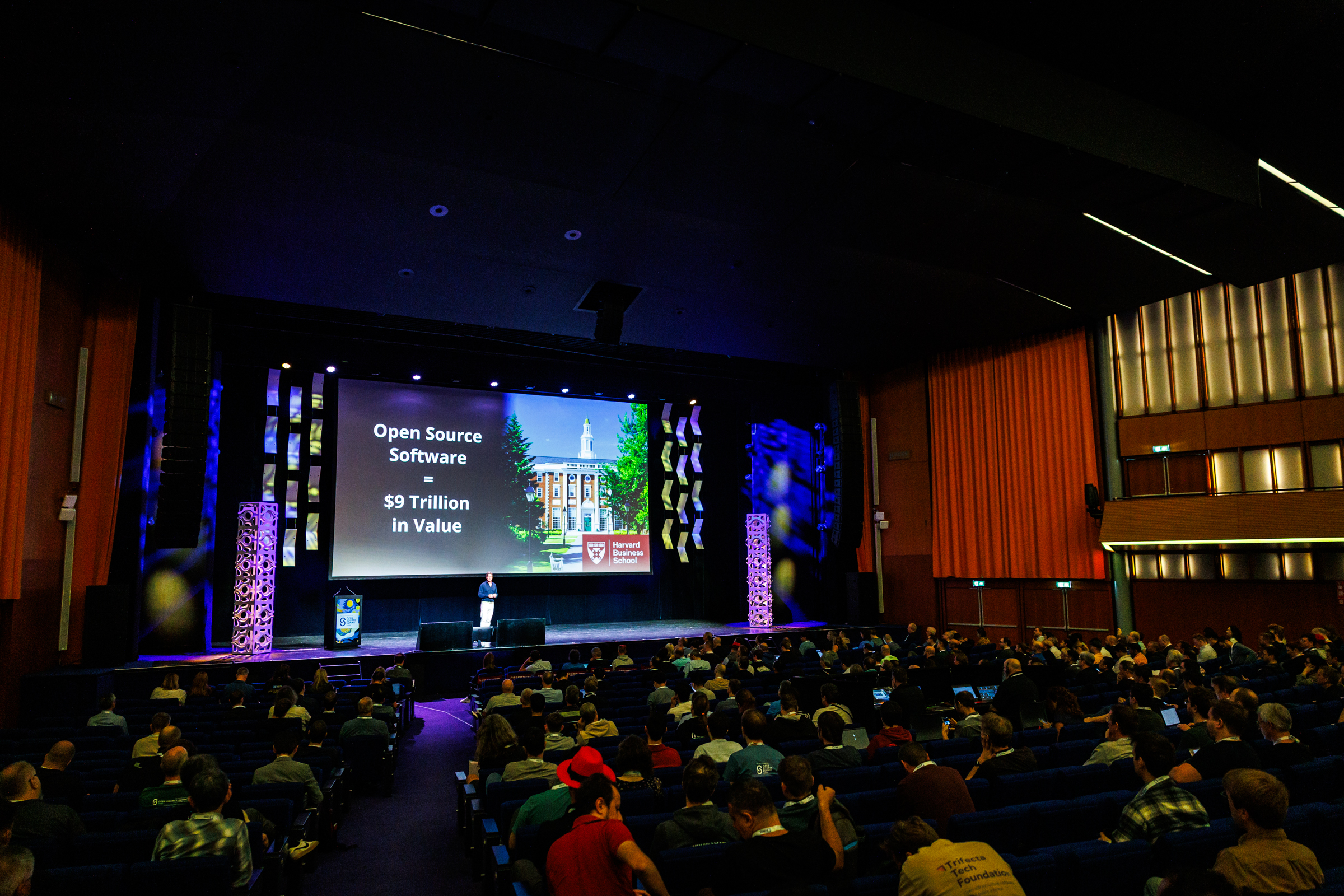
The ELISA Project participated in Open Source Summit Europe 2025 (August 25–27, Amsterdam), the premier gathering for open source developers, technologists, and community leaders. With over 2,000 attendees representing 900+ organizations, the event showcased the strength, diversity, and innovation of the ecosystem.
For ELISA (Enabling Linux in Safety Applications), the summit was an invaluable opportunity to engage with developers, architects, and functional safety experts working at the intersection of Linux and safety-critical systems. ELISA was featured prominently in the Safety-Critical Software Summit, where sessions explored topics such as kernel safety, automotive innovation, and compliance and trust in regulated environments.
Sessions covered a wide range of important topics, including kernel safety (identifying weaknesses, fault propagation, and Linux as a safety element out of context), automotive innovation (safe platforms, prototyping frameworks, and software-defined vehicles), and compliance and trust (continuous compliance, traceability, and statistical methods in safety analysis). These talks reflected the growing maturity of the ecosystem and highlighted the shared challenges the community is tackling from technical methodologies to regulatory alignment.
This week we highlight two talks from the Safety Critical Summit session:
Insights Into the Safe Open Source Vehicle Core Project for SDV – Philipp Ahmann, Etas GmbH (BOSCH)
The Safe Open Source Vehicle Core (S-Core) project, presented by Philipp Ahmann of ETAS (Bosch), is a collaborative, code-first effort to build a safety-certifiable middleware stack for software-defined vehicles (SDVs). Targeting the layers above the operating system, S-Core complements ELISA’s work and aims for ISO 26262, ASPICE, and ISO 21434 compliance. It supports POSIX-based systems like Automotive Grade Linux and Zephyr, is developed in C++ and Rust, and offers a VS Code-based dev environment with containerized builds.
Using a docs-as-code workflow with Sphinx, PlantUML, and Bazel, S-Core tightly links documentation, code, and testing through automated CI. Modules such as IPC, logging, and data persistence are under active development, with contributions from 70+ developers across 10+ companies.
Following a V-model safety process, S-Core builds in traceability, audits, and ASIL-B-level rigor, while distributors will handle final certification and integration. With a 0.5 release planned for late 2025 and 1.0 in 2026, the project is establishing a shared, open, and certifiable foundation for the next generation of safety-critical automotive software.
AutoSD: A Linux Development and Prototyping Framework for the Automotive Community – Alessandro Carminati & Gabriele Paoloni, Red Hat
AutoSD presented by Alessandro Carminati and Gabriele Paoloni (Red Hat) is an upstream, community-driven Linux distribution for automotive, backed by the CentOS Automotive SIG and serving as a public preview of Red Hat’s in-vehicle OS. Built on CentOS Stream, AutoSD adds automotive essentials: a real-time tuned Linux kernel, OSTree for transactional, rollback-safe updates, and containerized mixed-criticality so safety functions can run alongside infotainment without interference. A docs-as-code + CI approach keeps code, tests, and documentation aligned; images are declaratively built (YAML) via the Automotive Image Builder/OSBuild toolchain, and shipped as a binary distro for fast, reproducible onboarding.
A major focus is hardware enablement without the usual pain. If a SoC/board is already supported, you can boot prebuilt images and prototypes immediately. If drivers are upstream, contributors can add and maintain support in AutoSD under an upstream-first policy. For newly supported silicon, teams can evaluate quickly using a vendor BSP (“Frankenbuild”) but are encouraged to move to out-of-tree modules built against AutoSD’s stable kernel ABI for a maintainable, near-production path while upstreaming progresses.
Safety is treated as architecture, not afterthought: namespaces/cgroups isolate workloads, containers enforce domain boundaries, the kernel is real-time tuned, and intensive stress/fuzz testing (e.g., syzkaller + KASan) underpins freedom-from-interference claims. In Red Hat’s commercial in-vehicle OS, the same model maps to ASIL-B safety partitions (with a hardware watchdog and hardware-specific certification), while AutoSD remains the open, rapid-prototyping lane. Tightly aligned with communities like ELISA and Eclipse SDV, AutoSD offers a reference framework the industry can actually build on: contribute patches, enable new SoCs, propose features, and help shape a secure, updatable, and certifiable Linux base for software-defined vehicles.
What’s Next?
If you are interested in shaping this work, we invite you to join ELISA working groups and contribute to advancing safety practices in open source together.