
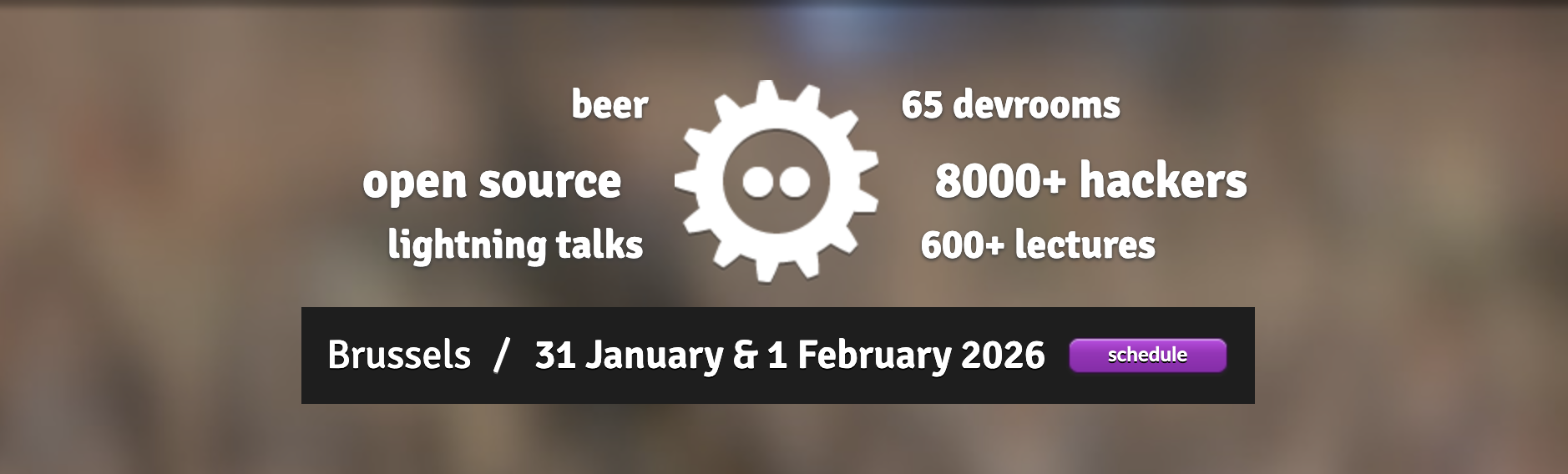
FOSDEM is a free event for software developers to meet, share ideas and collaborate. Every year, thousands of developers of free and open source software from all over the world gather at the event in Brussels.
The ELISA Project Ambassadors will be at FOSDEM 2026, actively participating across the event. They will be giving presentations, joining discussions, and meeting contributors and attendees in various developer rooms throughout the weekend. You can also connect with them at the Linux Foundation Europe stand, where they will be available to talk about ongoing work, community activities, and how to get involved with ELISA.
In addition, Philipp Ahmann, ELISA TSC Chair, Systems and Automotive WG Chair, and Sr. OSS Community Manager at ETAS GmbH (BOSCH), will be giving a talk at FOSDEM 2026. Philipp will also be at the Linux Foundation Europe stand throughout the weekend for anyone who would like to learn more about the ELISA Project, ask technical questions, or discuss collaboration opportunities.
From the TSC, Kate Stewart (VP, Dependable Embedded Systems, The Linux Foundation) and Nicole Pappler (Senior Safety Expert & Founder at AlektoMetis.com) will also be at FOSDEM.
Session Highlight:
Code, Compliance, and Confusion: Open Source in Safety-Critical Products
Open source is increasingly finding its place in functionally safe, safety-critical systems but adoption remains complex. This talk explores the rapid progress of OSS in functional safety across Linux, Zephyr, Xen, and automotive middleware, while also addressing the real barriers holding it back, from certification uncertainty to misunderstood safety concepts. Learn more.
BoF/Unconference
BOF: Linux & Open Source Software for safety applications in Railways (Jan 31, 2026 11:00 am – 11:55 am)
Digitization requires efficient software development. Today, this is no longer financially viable without the massive reuse of existing components and thus without the use of open source software as a generic product, also in the context of safety applications. Therefore, ways and means must be found to make open source software usable on a large scale for the railway sector. Due to the cooperative nature of open source software and the low competitive differentiation in the use of such generic products, the collaboration of various stakeholders from the sector under the governance of a Foundation can useful and important. This BOF wants to explore, if there is a critical mass to start a foundational backed project initiative for better spread of awareness for OSS in Railways and which activities exist to expand this approach for the safety-critical parts.
Safety-Critical Linux: Challenges across industries (Sat, Jan 31 – 12:00pm – 12:55pm)
Linux is being used more often in safety-critical areas like cars, planes, medical devices, robots, and trains. But each industry faces similar challenges when trying to meet safety and certification requirements. This BoF is an open discussion about those real-world problems: timing and determinism, documentation, certification, tooling, and system design. Anyone interested in safety-critical Linux is welcome to join, share experiences, ask questions, and explore where collaboration could help. Learn more.